
What is contractor management? From invitation to exit at your site
Managing external firms from the invitation to the moment they leave: what it is made of, how it differs from visitor management, and what to check in a system.
 Filip Mančák, Business Development Manager, aReception.ai · 4 min read
A service company arrives to maintain a production line with a crew of fitters. The plant handled the induction and the risk acknowledgment with different people from the ones now standing at the gatehouse. The guard has a list of names, and the signatures sit in a binder from last month. One of the sites we spoke with summed it up: “It's the wild west, sometimes the firms aren't checked at all.”
What is contractor management?
Contractor management is how a site manages external firms and their workers who do work on its premises: maintenance, servicing, installation, inspections and shutdowns. It covers who may come and when, which documents and training must be valid, how the site and the contractor inform each other about risks, who is on site right now, and what record each entry leaves. In a wider sense it also covers choosing the contractor, the contract and the review after the job. Procurement handles those. For the EHS manager and the gatehouse, contractor management starts with the invitation and ends when the worker leaves the site.
What it looks like at sites today
Contractors' workers also do high‑risk work on site: on electrical equipment, at height or with open flames.
In our calls with manufacturing sites, the most common story is paper at the gatehouse and contractor documents sent back and forth by email: “we send it by email and then they send it back to us scanned.” The validity of training and certificates is tracked in a spreadsheet, and a firm sometimes sends different people from the ones the site inducted. One automotive plant described what it is missing: “They don't check the induction or the site risk acknowledgment. I'd need it so that if this person wasn't inducted, we simply don't let them in.”
The risk acknowledgment is often partly on paper and partly in emails. Before a customer audit, someone searches for the signed version, and it costs the EHS manager two to three days.
What contractor management is made of
- 1Invitation and documents in advance: who is coming, when and with which certificates.
- 2Site risk acknowledgment: the site and the contractor inform each other about the risks at the workplace, and both sides confirm it with a signature.
- 3Safety induction in a language the worker understands, and its signature.
- 4Entry to the site only for those whose training and documents are valid.
- 5A live view of who is on site, also for evacuation.
- 6Exit and a record of every entry: who, when, with which induction and signature.
- 7Validity tracking: training and documents are renewed before they expire.
Visitor management needs only part of this. A visitor usually comes once, for a meeting, and a short briefing is enough, perhaps with an NDA to sign. A contractor's worker comes back again and again, carries documents with their own expiry dates, their work changes the risks in the hall, and the induction has to fit the job. Each group therefore needs its own process at the entrance.
What to check when choosing a system
- Risk acknowledgment signed by both sidesWhen the site changes its risks, the system asks the contractor to acknowledge them again.
- Document validity for each workerWelder or electrician certificates are tracked for the individual person, with a reminder before they expire.
- Entry tied to the inductionConnected to a turnstile or gate arm, it lets through only those who completed and signed the induction.
- The worker's languageThe interface is in the technician's language, the induction content in the languages the site provides.
- A record for audits and accidentsA report lists each person and shows who was on site when, which induction they had and their signature.
In aReception, the contractor completes the risk acknowledgment through a link in the invitation before arriving, and can complete the induction too. Whatever is left, they finish and sign at the kiosk. Artifex in Lozorno, an automotive interiors supplier, has 220+ visits a month, and 73+ safety inductions are signed at its kiosk every month. Its gatehouse used to run on paper. The Artifex case study describes the whole process.
Keep reading
Related articles and case studies
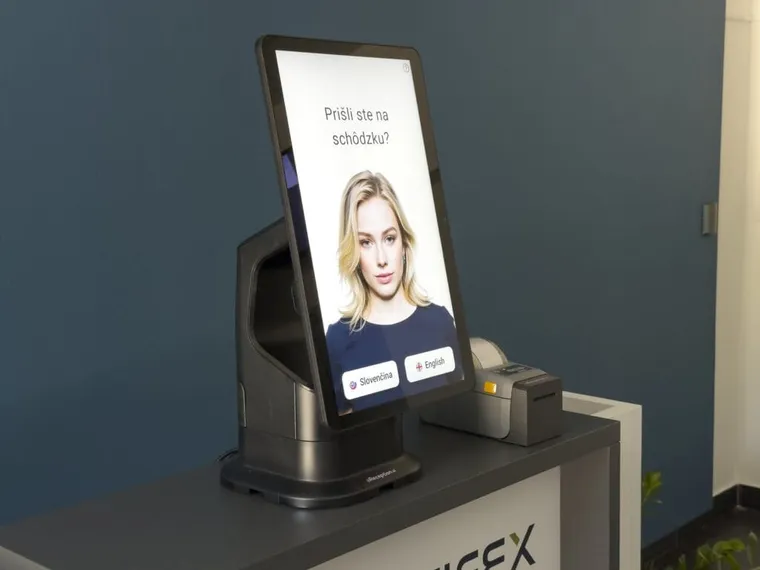 Manufacturing and industryArtifexLozorno, Slovakia
Visitor and contractor check‑in at an automotive supplier: bilingual, without a permanently staffed front desk.
- saved every month
- €1,700
- visitors a month
- 220+
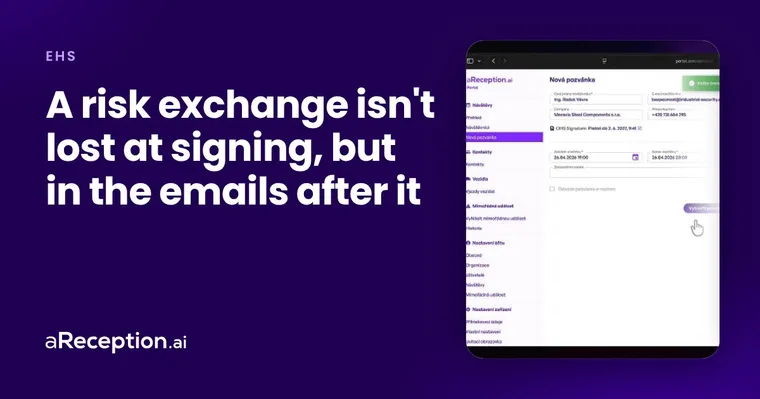 BlogSigned risk acknowledgments get lost in the emails after signing10 October 2026 · 3 min read
Plants do get risk acknowledgments signed by their contractors. The signed version gets lost afterwards, in emails and binders. How Model Obaly in Opava solves it.
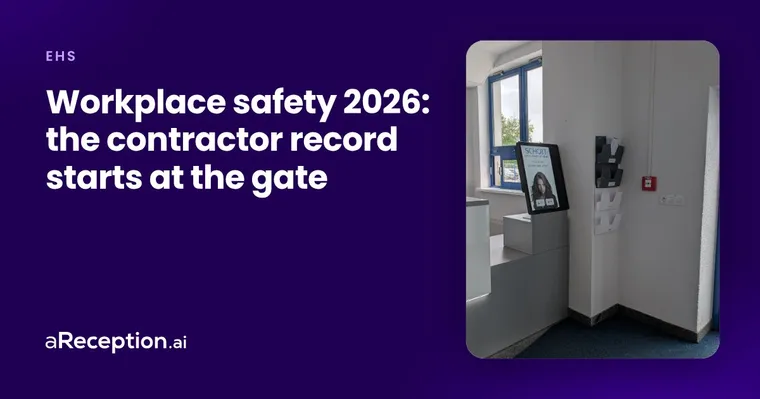 BlogWorkplace safety 2026: the contractor record starts at the gate10 March 2026 · 3 min read
2026 brought contractors no new paperwork. It brought the question of who was on site when, with which induction. The answer has to start at the gate.
Are your contractor entries still on paper?
In 15 minutes, we'll show you the risk acknowledgment, the induction in advance and the report for one contractor. We reply within one business day.
Got it. We will get back to you within one business day.
In the meantime, watch a one‑minute video from a live site.
Pick a time nowTrusted at 70+ sites
Stora Enso 
Model Obaly 
Artifex 
ELVAC


 Filip, Tomáš or Luboš will replySales and deployment at aReception · we reply within one business day